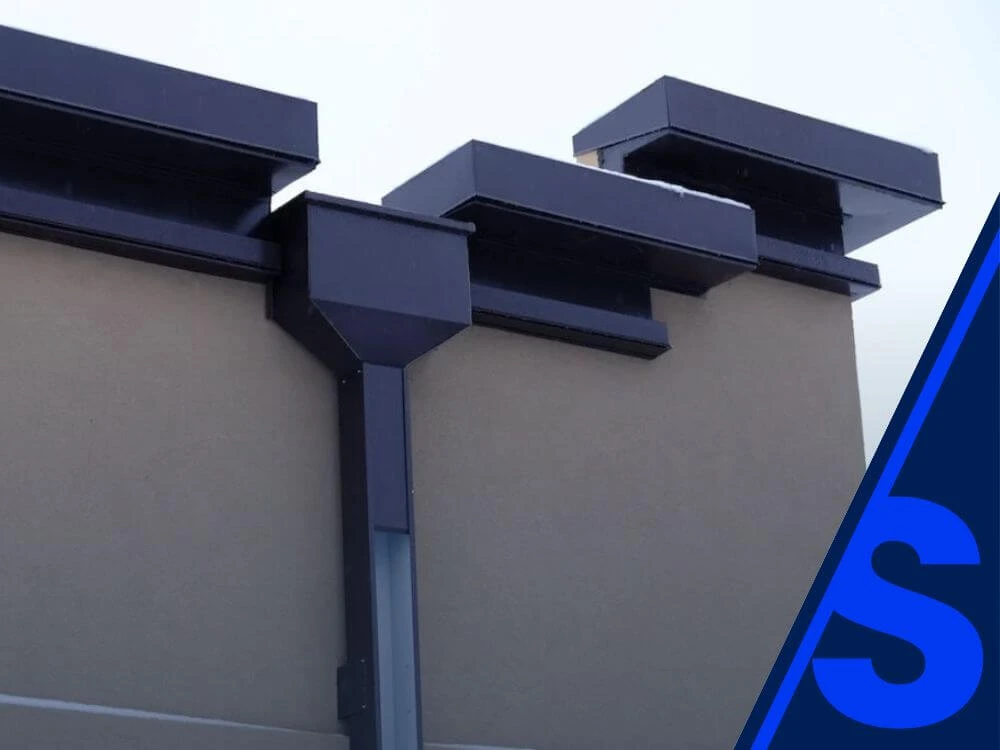
Roof scuppers are required by the International Building Code (IBC) and International Residential Code (IRC) as a secondary or emergency overflow drainage system on any roof where water could be trapped if the primary drainage system fails. This most commonly applies to low-slope or flat roofs with parapet walls or perimeter conditions that prevent water from freely draining off the roof. Properly designed and code-compliant scuppers help prevent structural overload, roof collapse risk, and inspection failures.
Are scuppers necessary?
Scuppers are necessary when a roof design includes parapet walls or other conditions that can trap water. In these cases, codes require a secondary drainage method to safely remove excess water if primary drains become blocked.
What are scupper drain requirements?
Scupper drain requirements typically mandate sizing based on rainfall intensity, roof area, and discharge location. They must be located above the primary drain level and sized to handle emergency overflow conditions.
What is the roof live load required by the IBC?
The IBC generally requires roofs to be designed for a minimum live load of 20 pounds per square foot, with additional considerations for rain-on-roof loads where drainage may be impeded.
How many roof drains are required?
Most codes require at least two drains or a primary drain with a secondary overflow system such as scuppers. The exact number depends on roof size, configuration, and local amendments.
Roof drainage design is one of the most commonly overlooked risk areas in new construction, yet it is also one of the most heavily scrutinized during plan review and inspections. Builders working with low-slope or flat roofs must account not only for everyday drainage but also for failure scenarios. This is where roof scupper code requirements become critical.
Roof scuppers are not a design preference or an optional detail. In many situations, they are a mandatory life-safety and structural protection feature required by the IRC and IBC. Understanding when scuppers are required, how they function, and how inspectors evaluate them can help builders avoid costly redesigns, inspection delays, and long-term liability.
Understanding Roof Scuppers in Modern Construction
What Is a Roof Scupper?
A roof scupper is an opening placed through a parapet wall or roof edge that allows water to drain off a roof surface. Unlike internal roof drains, scuppers provide a visible discharge point and function primarily as an emergency overflow system.
Scuppers are most commonly associated with flat or low-slope roofs where perimeter walls prevent water from naturally draining off the roof. Without scuppers, water can accumulate rapidly if a primary drain becomes clogged, leading to excessive loading on the roof structure.
Primary vs Secondary Roof Drainage
Roof drainage systems are typically divided into two categories. Primary drainage handles normal rainfall and consists of internal drains or gutters. Secondary drainage is designed for emergency conditions when the primary system fails.
Roof scuppers fall squarely into the secondary drainage category. Codes do not assume that primary drains will always function perfectly. Leaves, construction debris, and mechanical failures are all anticipated risks. Scuppers provide redundancy that protects the building during these events.
Why Roof Scupper Code Requirements Exist
Structural Risk of Ponding Water
Standing water on a roof adds significant weight. One inch of water weighs more than five pounds per square foot. During heavy storms, water depth can increase quickly if drainage is blocked.
IBC roof scupper code requirements are directly tied to preventing structural overload. Scuppers are intended to limit how deep water can accumulate before safely exiting the roof.
Rain-on-Roof Load Calculations
The IBC requires designers to consider rain loads in addition to live loads. When a roof does not have adequate secondary drainage, rain-on-roof loads can exceed structural capacity.
Scuppers reduce this risk by limiting the maximum water depth that can build up on the roof surface. This is especially important for roofs with large surface areas and parapet walls.
IRC vs IBC Roof Scupper Requirements
IRC Roof Scupper Code Requirements
The IRC generally applies to one- and two-family dwellings and townhouses. While the IRC is less complex than the IBC, it still requires provisions for secondary drainage where roof design could allow water to accumulate.
In residential applications with parapet walls or enclosed roof edges, IRC roof scupper code requirements often mirror the intent of the IBC by requiring overflow drainage to prevent structural damage.
IBC Roof Scupper Code Requirements
The IBC applies to commercial buildings and multifamily projects. Its requirements for secondary drainage are explicit and detailed.
IBC Section 1502 and Section 1108 require secondary roof drainage systems when primary drains are used. Scuppers are one of the accepted methods, provided they are sized correctly and located above the primary drain elevation.
Expert Insight on Code Intent
According to guidance published by the Federal Emergency Management Agency and referenced in FEMA’s building science resources, secondary roof drainage systems are essential to prevent progressive structural failure during extreme rainfall events. The International Code Council also emphasizes that overflow drainage is required to protect roof structures when primary systems become obstructed. This guidance reinforces why roof scupper code requirements are treated as a life-safety issue rather than a design preference.
When Roof Scuppers Are Required
Low-Slope and Flat Roofs
Scuppers are most commonly required on roofs with slopes less than 2:12 where water does not naturally drain to the roof edge. These roofs rely entirely on engineered drainage systems.
If such a roof includes parapet walls, scuppers are almost always required as part of the secondary drainage system.
Roofs With Parapet Walls
Parapet walls create a perimeter barrier that traps water on the roof surface. Without scuppers or secondary drains, there is no escape path for water if primary drains fail.
IBC roof scupper code requirements are especially strict for parapet conditions because of the elevated risk of ponding.
Large Roof Areas
The larger the roof, the greater the potential volume of water during a storm event. Large roof areas often require multiple scuppers spaced around the perimeter to ensure adequate overflow capacity.
Scupper Design and Placement Considerations
Elevation Above Primary Drains
Scuppers must be installed at a higher elevation than primary roof drains. This ensures that they only activate during emergency conditions and do not interfere with normal drainage.
Code officials often check scupper elevations during inspection, making this a frequent source of field corrections when improperly installed.
Location and Discharge
Scuppers must discharge to a location where water will not damage the building, adjacent properties, or pedestrian areas. Improper discharge can create erosion, staining, or safety hazards.
Builders should coordinate scupper placement with site drainage plans early in the design process.
Sizing Requirements for Roof Scuppers
Rainfall Intensity
Scupper size is based on local rainfall rates, often measured in inches per hour. Jurisdictions typically reference rainfall data tables included in the plumbing code or IBC.
Failing to size scuppers correctly can result in plan review rejections or failed inspections.
Roof Area Served
Each scupper must be sized to handle the portion of the roof it serves. Larger roofs may require multiple scuppers to meet code requirements.
Common Builder Mistakes With Roof Scuppers
Treating Scuppers as Optional
One of the most common errors is assuming scuppers are optional when internal drains are present. Codes require redundancy, not one or the other.
Improper Elevation
Scuppers installed too low can act as primary drains, while scuppers installed too high may not activate in time to prevent excessive ponding.
Coordination Failures
Scuppers often involve coordination between roofing, framing, waterproofing, and exterior finishes. Lack of coordination can lead to leaks or code violations.
Inspection and Plan Review Considerations
What Inspectors Look For
Inspectors typically verify scupper size, elevation, waterproofing integration, and discharge location. Missing or undersized scuppers are common causes of failed inspections.
Documentation and Details
Clear construction details showing scupper dimensions, elevations, and waterproofing transitions can streamline plan review and reduce field corrections.
Integrating Roof Scuppers Into Builder Workflows

Early Design Coordination
Addressing roof scupper code requirements early allows builders to avoid late-stage redesigns. Coordination with structural engineers and architects is essential.
Quality Control During Installation
Scuppers require precise installation to maintain waterproofing integrity. Quality control checks during roofing installation help prevent leaks and callbacks.
Long-Term Risk Mitigation
Structural Protection
Scuppers are a low-cost feature that protects against high-cost failures. Structural repairs caused by ponding water far exceed the cost of proper scupper installation.
Liability Reduction
Proper compliance with roof scupper code requirements reduces exposure to claims related to water damage, structural failure, and code violations.
Conclusion
Roof scuppers play a critical role in protecting buildings from water-related structural risk. Under both the IRC and IBC, scuppers are required whenever roof designs create the potential for trapped water, particularly on low-slope roofs with parapet walls. Builders who understand and properly implement roof scupper code requirements can avoid inspection failures, reduce long-term liability, and deliver more resilient projects.
Key Takeaways
- Roof scuppers are required as secondary drainage where water could be trapped.
- IBC and IRC both mandate overflow drainage for certain roof designs.
- Scuppers must be sized, located, and elevated correctly to meet code.
- Early coordination and proper installation reduce inspection issues.
- Scuppers protect both structural integrity and builder liability.
If you are planning a project with low-slope roofs or parapet walls and want to ensure your drainage design meets all IRC and IBC requirements, consult with experienced roofing professionals early in the process. For guidance on code-compliant roof drainage systems and new construction roofing solutions, contact CitySide Roofing today.
Related Reading: